Why relying on historical award data is costing contractors wins and how to build a defensible, market-anchored pricing strategy consistent with pricing policy to procure goods and services from responsible sources at “fair and reasonable” prices described under FAR 15.402.
—
When preparing your #govcon proposal, you must understand how they will be evaluated from a pricing perspective and whether there will be adequate competition. Under proposal analysis techniques described under FAR 15.404-1, Contracting Officers are charged with determining whether a proposal’s pricing is “fair and reasonable” based on the competition, or the next best evaluative techniques starting with historical prices paid.
Yet across federal procurement, proposal teams keep making the same mistake: treating historical contract prices as gospel. A rate that won five years ago gets copied into this year’s model with a light escalation factor slapped on top and the proposal gets submitted on time.
The problem is that yesterday’s winning rate doesn’t know about this year’s wage inflation, regional labor shifts, or the fact that your top competitor just restructured their fringe pool. When an acquisition file leans heavily on stale award data, it puts both proposal defensibility and contract profitability at risk. Overbid, and you lose on price. Underbid based on rates from a tighter labor market, and you win a contract you can’t staff without burning into your margin.
The Four Dimensions of Price Reasonableness
A pricing model that holds up to CO scrutiny — and still protects your margin — has to account for four things at once:
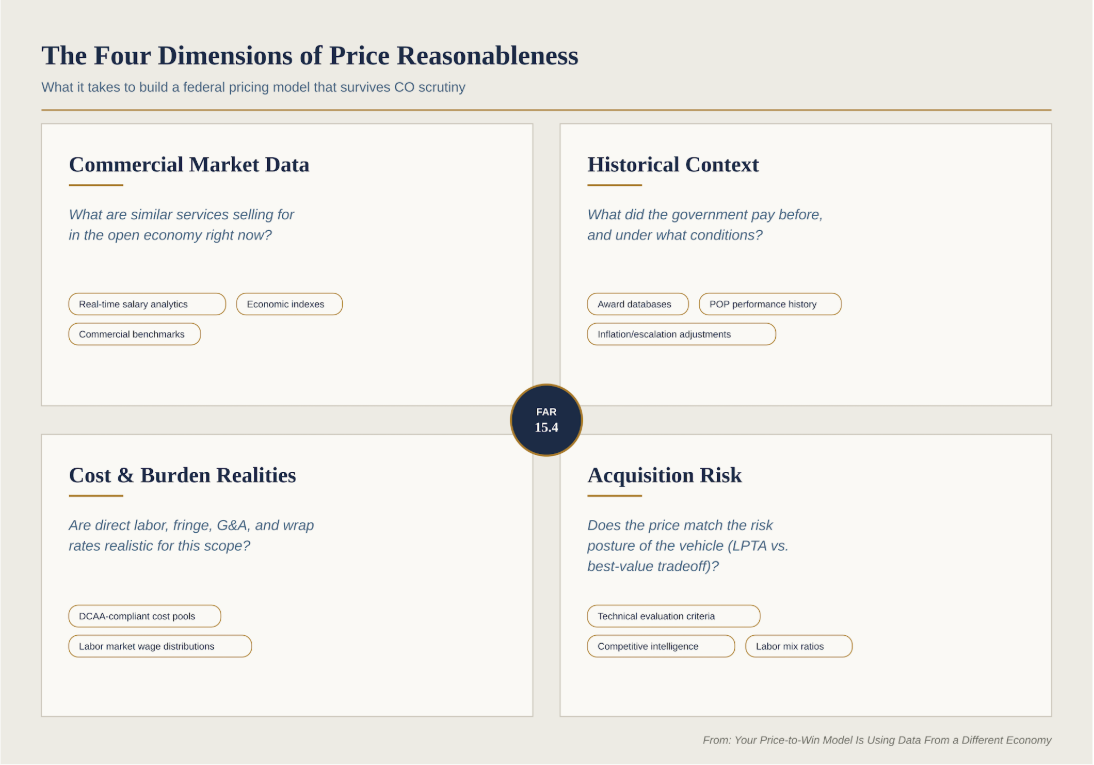
Historical data covers exactly one of these four boxes. Teams that stop there are building three-quarters of a pricing strategy and calling it done.
Turning the Framework Into a Workflow
The four dimensions above are the “what.” Now here’s the *how:” a repeatable workflow capture and pricing teams can run on every bid without reinventing the process each time:
-
Standardize the labor categories first.
Before you price anything, map SOW requirements to market-standard occupational codes.
Translating client LCATs into standardized descriptors—such as BLS OEWS and GSA MAS
categories—early in capture means comparing apples to apples instead of guessing at
equivalencies later. -
Pull local market data, not a national salary guide.
A single national average masks wide differences between, for example, Huntsville and
the National Capital Region. Location-specific, industry-adjusted labor data gets you
closer to what it actually costs to recruit and retain talent for this contract, in
this labor market. -
Model what your competitors are probably doing.
Overlay competitive intelligence on rival primes’ likely fringe burdens, overhead,
general and administrative (G&A) indirect-cost pools, and fee expectations. This
approximates the pricing against which your proposal will be evaluated and provides a
crucial input to your probability of win. -
Solve for the PTW target point, not just a defensible number.
The goal is not merely a total price you can justify to a Contracting Officer. It is the
price ceiling that maximizes probability of win while preserving execution margin. That
means adjusting senior-to-junior labor ratios, indirect allocations, and fee structure
until probability of win and profitability intersect—not simply choosing whichever
number is easiest to defend on paper.
The Bottom Line
Historical pricing data tells you where the market was. Real-time labor market analytics tell you where the market is. Teams that keep running the old workflow aren’t just leaving PWin on the table; they’re building acquisition files that are harder to defend and contracts that are harder to staff at the rates they bid.
Shifting your cost-volume strategy to current market intelligence isn’t an extra step. It’s the step that makes the other three dimensions of price reasonableness actually hold up.